Technology overview
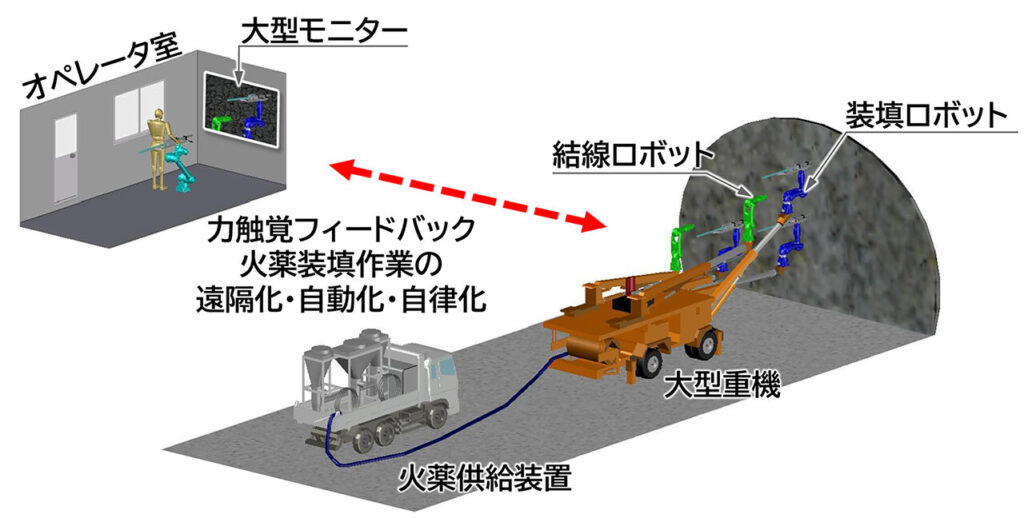
Obayashi Corporation, in collaboration with Keio University, announced on January 20, 2026, the successful development of an automated explosive loading system utilizing “Real Haptics” technology to achieve unmanned operations at the tunnel face. This system allows a single operator to perform delicate explosive charging tasks from a remote station located 50 meters away, effectively removing workers from high-risk zones. By incorporating a new primer supply device and advanced tactile feedback, the robot replicates human sensitivity, ensuring safe and continuous loading. Real Haptics transmits force and touch information bidirectionally, providing the operator with an intuitive “feel” of the task as if they were physically present. This innovation marks a significant leap in tunnel construction safety, addressing the long-standing challenge of automating hazardous manual labor.
Original news release: https://www.obayashi.co.jp/news/detail/news20260120_1.html
Background
Mountain tunnel excavation involves significant risks, particularly from “Rockfall”—the accidental falling of rocks from the tunnel face. While automation has progressed in drilling and hauling, explosive loading has traditionally required manual intervention due to the sensitivity of the materials. Handling explosives and managing thin detonator wires require precise force control and a human sense of touch that standard remote-controlled machinery could not provide. As the construction industry grapples with an aging workforce and labor shortages, there is an urgent demand for technologies that can move human workers away from dangerous areas without sacrificing the quality of complex tasks. The integration of Real Haptics was driven by the need to digitize human dexterity, allowing for remote operations that are as reliable as on-site manual work, thereby ensuring both safety and productivity in challenging geological environments.
Advantages
The system transforms a high-risk manual process into a safe, one-person remote operation. By providing real-time tactile feedback, it ensures precision handling while significantly reducing the required personnel.
Comparison Table
| Comparison Item | Conventional Method (Manual) | Real Haptics System |
|---|---|---|
| Safety | High risk (Work directly under the face) | Safe (Remote operation from 50m away) |
| Required Personnel | 5 workers | 1 operator |
| Precision | Dependent on manual dexterity | Intuitive control via force-feedback |
| Work Continuity | Intermittent manual supply | Continuous via automated supply device |
Potential Applications
Future developments include the full automation of wire connections and integration with autonomous heavy machinery to create a completely unmanned tunnel excavation cycle. Beyond mountain tunnels, this technology is applicable to any high-risk environment requiring delicate manipulation, such as underwater maintenance, disaster response, or nuclear decommissioning. By digitizing human touch and skill, Obayashi is setting a new global benchmark for construction technology. This shift will not only improve safety and efficiency but also redefine the role of the construction worker in the digital age, making the industry more attractive to a tech-savvy workforce.
日本語ページはこちら:https://hatara-kuma.com/20260203-2/