Technology Overview
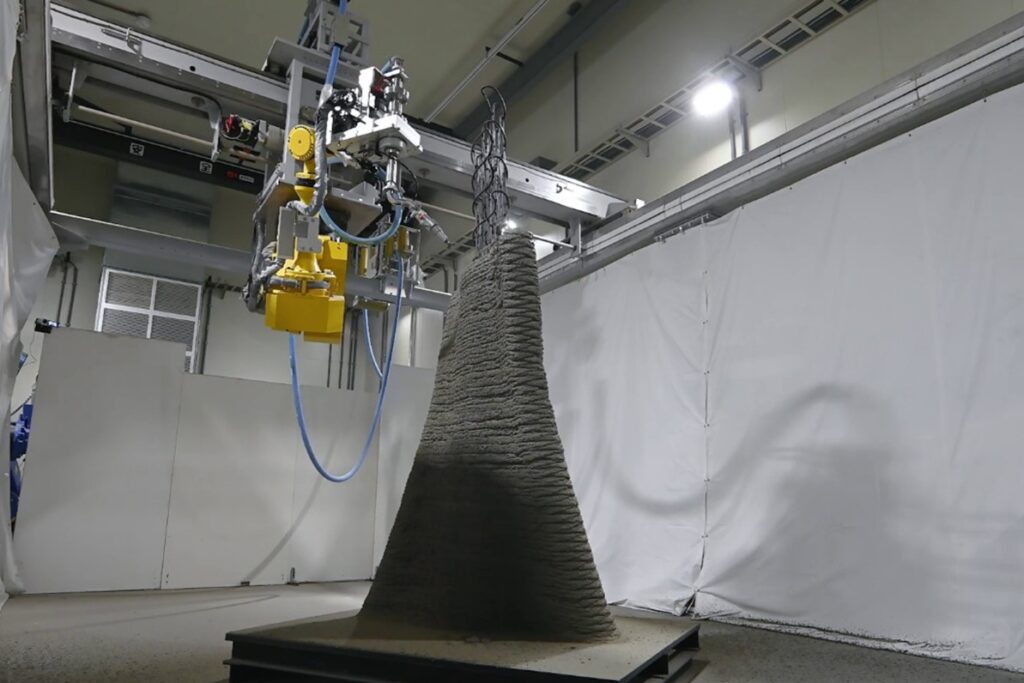
Shimizu Corporation has announced the development of a spray-based 3D concrete printing system designed to automate the construction of large, complex curved structure. Unlike traditional extortion laying methods, this system utilizes a 9-degree-axial gantry robot and a high-precision material spray simulator co-developed with Carnegie Mellon University. By simulating material behavior and optimizing nozzle paths before execution, the system achieves unprecedented accuracy in fabricating reinforced structural elements. In recent demonstration tests, the technology successfully produced a 2.5-meter-high twisted curved wall in just four hours, showcasing its potential for high-speed, high-quality production without manual formwork. This innovation marks a significant leap toward the full automation of concrete construction. Full News Release: https://www.shimz.co.jp/company/about/news-release/2025/2025047.html
Background
The Japanese construction industry is currently facing a critical labor shortage driven by an aging population and a declining working-age demographic. To maintain productivity, there is an urgent need for automation and labor-saving technologies. While 3D concrete printing has seen global progress, the mainstream “material extrusion” method—which deposits layers from above—struggles with structural reinforcement. Specifically, it is difficult to incorporate reinforcement (rebar) into the layering process, often limiting its use to non-structural elements. Although spray-based printing is inherently better suited for reinforced structures, controlling the complex dynamics of sprayed material has historically made it difficult to maintain geometric precision. Shimizu’s system addresses these challenges by integrating advanced robotics with digital twin simulations, enabling the automated fabrication of structural concrete that previously required intensive manual labor and expensive, specialized formwork.
Advantages
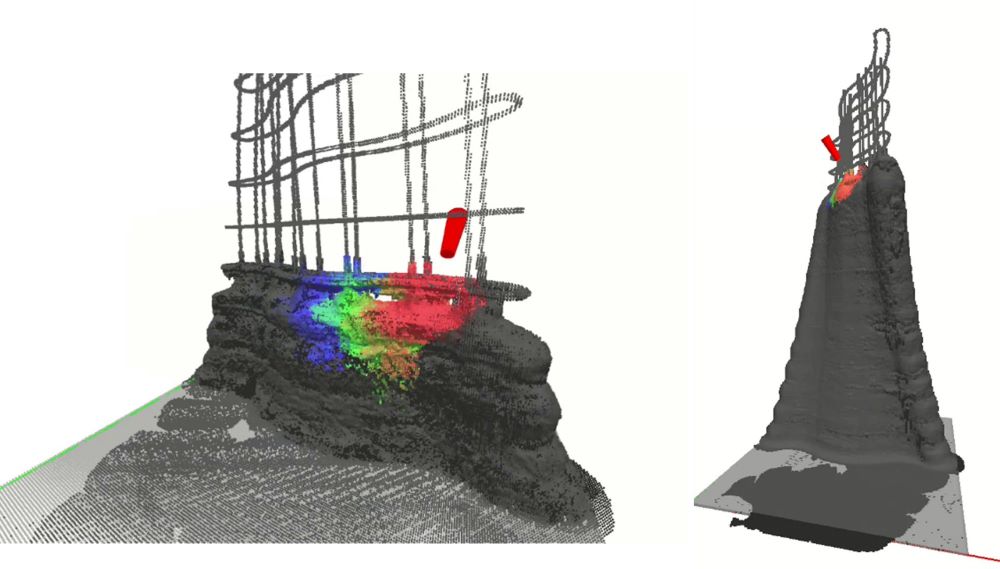
This system offers superior precision and structural integrity compared to conventional extrusion methods. By using parallelly developed spray simulator, parameters such as nozzle angle and discharge volume are optimized to minimize material waste and defects.
| Feature | Conventional Material Extrusion | Shimizu Spray-Based System |
|---|---|---|
| Reinforcement | Extremely difficult to incorporate | Specifically designed for reinforced structures |
| Design Flexibility | Limited mainly to vertical layering | High (Complex curves and overhangs) |
| Accuracy Control | Manual or basic sensor feedback | via Spray simulator |
| Efficiency | Slower layer-by-layer deposition | Rapid fabrication of large components |
Potential Applications
The implementation of this technology is set to transform construction sites by allowing the automated production of reinforced structural components. Beyond standard walls, it enables the creation of complex, organic designs that were previously cost-prohibitive due to the difficulty of creating custom formwork. In the future, this system will significantly reduce the required workforce and shorten construction schedules. Shimizu aims to refine this technology further to achieve full site automation, potentially applying it to large-scale infrastructure like bridges, building cores, and unique architectural landmarks, evolving the construction process into a high-tech, digital-driven industry.
日本語ページはこちら https://hatara-kuma.com/20250108-2/