Technology Overview
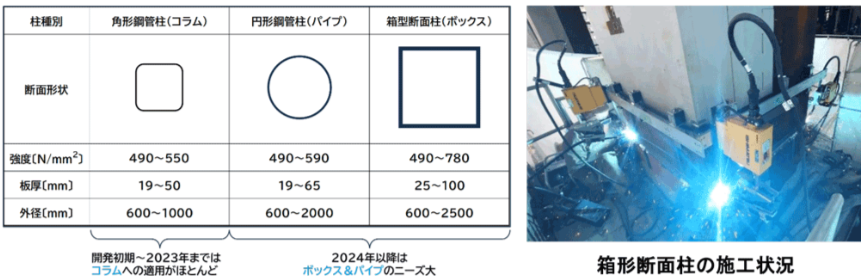
On November 13, 2026, Taisei Corporation announced the expanded deployment and operational reinforcement of its automated field welding robotic construction method, “T-iROBO Welding.” Originally introduced for square steel pipe columns in 2016, the latest advancement extends the system’s applicability to box-section columns, circular steel pipe columns, and complex diagonal columns commonly used in modern skyscrapers. To support multiple large-scale projects simultaneously, Taisei has increased its fleet to 32 welding robots and trained 12 dedicated “Robot Welding Trainers.” This comprehensive upgrade aims to accelerate labor savings, enhance construction productivity, and maintain consistent high quality across major urban developments. For more details, see the original news release: Taisei Corporation News Release.
Background
The development and expansion of “T-iROBO Welding” are driven by critical structural and demographic pressures facing the modern construction industry. Chief among these is the severe shortage and aging of skilled welding technicians. In steel-structure buildings, field welding is indispensable for joining heavy structural columns; however, it demands high technical expertise, physical endurance in high or confined spaces, and rigorous quality control. In large-scale projects, the sheer volume of welding work creates a major bottleneck, directly impacting project timelines. Furthermore, conventional welding robots were mostly limited to standard square steel pipe columns, leaving thick-walled box-section columns, large circular pipes, and intricate diagonal columns entirely reliant on manual labor by skilled craftspeople. As labor shortages become increasingly acute and project scales grow, contractors urgently need scalable, automated solutions that can handle complex structural geometries while ensuring consistent quality and worker safety without relying solely on dwindling human resources.
Advantages
Compared to conventional manual or single-robot welding, Taisei’s updated “T-iROBO Welding” system delivers unprecedented efficiency. By enabling up to four robots to operate simultaneously on a single box-section column, it achieves over 200% of human-equivalent productivity, while supporting challenging geometries like diagonal columns with a robust trainer support system.
Comparison Table
| Comparison Item | Conventional Method (Manual / Basic Robot) | T-iROBO Welding (Latest 2026 System) |
|---|---|---|
| Main Workforce | Skilled welding technicians (semi-automatic arc welding) | Automated welding robots (2 to 4 units operating simultaneously per column) |
| Applicable Column Shapes | Limited; complex shapes heavily rely on human craftspeople | Square, box-section, circular steel pipe, and diagonal columns |
| Work Efficiency & Speed | Dependent on individual technician availability and skill levels | Exceeds 200% efficiency compared to human labor on box-section columns |
| Quality Consistency | Prone to variations based on operator fatigue and environmental conditions | Uniform, high quality maintained via automated preset controls |
| Operational Support | Dependent on subcontractor technician allocation | Backed by a fleet of 32 robots and 12 certified “Robot Welding Trainers” |
Potential Applications
Looking ahead, “T-iROBO Welding” is set to transform architectural design and future construction workflows. By bringing complex geometries like diagonal and box-section columns into the automated workflow, the technology removes previous design constraints, enabling architects and structural engineers to pursue bold, dynamic structural designs without fearing site-welding bottlenecks. Furthermore, the combination of a 32-robot fleet, multi-site deployment capabilities, and dedicated training staff paves the way for fully integrated human-robot collaborative job sites. This establishes a new construction standard where automated precision and data-driven efficiency drive large-scale urban developments across Japan and beyond.
日本語ページはこちら: https://hatara-kuma.com/20261104-2/